What Years of Studio Lighting Taught Me About Stage Presence
After three decades of standing under hot, unforgiving studio lamps, I have come to understand that the lights themselves are some of the best teachers a broadcaster can ever have. They expose every flicker of doubt, every breath held too tightly, every half-finished thought. They reward the moments when you commit fully and punish the ones where you do not. And slowly, almost without noticing, they reshape how you hold yourself in any room you walk into.
I think about this often when I am preparing for a live event in Melbourne or Sydney, or any of the corporate rooms I am booked into across the country. The principles I learned under a glare of four thousand kelvin are the same principles that travel with me onto a stage in a conference centre. They help a woman command a boardroom or a book club or a family dinner when something important needs to be said.
What follows is not a manifesto or a polished theory. It is a collection of practical things the lights taught me, things I have tested in studios, on red carpets, and in front of thousands of people in auditoriums. If you spend any part of your life being watched, whether by a camera or by a roomful of colleagues, I hope some of this lands.
The spotlight as a brutal but honest teacher
Studio lighting does not flatter you. It tells the truth. The angle of a key light will pick out a tense jaw, the bounce of a fill light will show whether your shoulders are lifting towards your ears, and the back light will highlight every uncertain step. For years I believed I had to fight the lights, to perform around them, to hide. Eventually I realised the lights were simply showing me what an audience already felt. The trick was not to hide from them but to learn what they were saying.
When I started hosting a live breakfast show, the first thing the director told me was to soften my shoulders. I had spent so long bracing for the close-up that my body had forgotten how to settle. Within a week I noticed the same tension creeping into the way I walked into meetings, and later into the way I greeted audiences in Brisbane. The lights had taught me a lesson my mind could not have absorbed on its own: presence begins in the body, not in the words.
A mentor once said to me, the lights do not make you nervous, they simply show you where your nerves already live. That single sentence changed how I prepared for every kind of performance afterwards. I started doing shoulder rolls in the wings of theatre shows, I started breathing into my back before I stepped onto a stage in Adelaide, and I started noticing the difference between being watched and being seen.
Reading the room when you cannot see the room
One of the strangest things about presenting on television is that you cannot see your audience. They are somewhere out there, in lounge rooms and waiting rooms, but you are sealed inside a brightly lit box. You have to read the room without seeing it, which sounds impossible, and yet it is something the lights force you to learn. You learn to read a producer's earpiece, a director's tiny hand gesture, the warmth of a co-host's silence. You learn to feel attention the way a sailor feels wind.
That skill has travelled with me to every corporate booking I have done. When I host a leadership summit in Perth, or a women's empowerment lunch in Canberra, I cannot see the back row, but I can feel whether they are leaning in. I can hear the texture of applause. I can read the speed of a joke landing. Studio training turns those subtle signals into a second language, and once you have it, you do not lose it.
I often tell clients who book me through the events page that the most underrated part of stage presence is listening. People assume presence is about volume, projection, taking up space. The lights teach you the opposite. The lights teach you that the quietest person in the room, the one who pauses and lets the silence work, is often the one the camera lingers on. That is the person an audience trusts.
| Studio habit | What it teaches you | How it shows up on stage |
|---|---|---|
| Dropping shoulders before a take | Physical tension is visible | Calmer posture in front of a live room |
| Reading the director's hand signals | Listening is a presence skill | Better audience awareness on stage |
| Pausing before you speak | Silence holds attention | Stronger impact of key lines |
| Treating the camera as one person | Intimacy at scale | Feeling of connection with a large crowd |
| Preparing the body, not just the words | Presence is physical | Walking onto a stage already settled |
Confidence is built before the lights come on
The moment before the studio lights ramp up is one of the most instructive moments in broadcasting. You can hear the set, you can hear the crew, you can hear your own heartbeat. Everything is still. Then the lights snap on and your job is to look as though you have been ready for hours. That tiny gap, that two-second breath between dark and light, is where confidence is actually built.
I used to fill that gap with notes, last-minute adjustments, quick chats with my makeup artist. Now I stand still. I drop my shoulders. I let my face settle. I think of one person I want to speak to, even if it is a million strangers in a million lounge rooms. Then the lights come up and I am already there. I do not travel to the moment. The moment arrives and I am already in it.
This is the part I find hardest to explain to women who are terrified of public speaking, which is most women I have ever met, including, frankly, myself on most days. Confidence is not a personality trait. It is a practice. It is something you do in the ten seconds before you are seen, not something you hope will appear once you are. The lights taught me that, and now I teach it every time I take a stage.
Translating studio skills to live audiences in Australia
Australia has a particular relationship with its speakers. The audience here appreciates directness, warmth, and a sense that you are not above them. They will forgive a lot if they feel you are genuinely in the room. They will forgive very little if they sense polish without substance. After years of broadcasting in British studios, I had to recalibrate what warmth meant when I started working events here. The accent of trust, if you like, is different in a ballroom in Sydney than it is in a studio in Wapping.
I learned early on that the Australian sense of humour rewards a certain kind of self-deprecation. A light, dry aside about yourself lands better than a grand declaration. I also learned that the pace of Australian corporate life moves differently. Things start on time, sometimes ahead of time. The room is less formal than equivalent rooms in London. People greet you with a cheerful how you going that actually means how are you, and they expect you to answer like you mean it.
There is also a real appetite here for stories about reinvention, which is something I have lived through more than once. When I speak about resilience or women's wellbeing, I find that Australian audiences are hungry for honesty about failure, not just triumph. They want the bit in the middle, the messy bit. They want the bit the cameras usually cut. That is a gift to a speaker, because the things the lights taught me to hide are exactly the things that land hardest on a stage in Melbourne.
Building a personal ritual before you step into the light
The lights taught me that how you arrive matters as much as how you perform. Over the years I have built a small ritual that I follow before any event, whether I am walking into a studio in Surrey or a conference centre on the Gold Coast. It is not fancy. It does not involve crystals or motivational playlists. It is just a sequence of physical and mental moves that tell my nervous system it is safe to be seen.
I breathe out longer than I breathe in. I unclench my jaw. I drop my shoulders. I think of one true thing I want the audience to walk away with. Then I walk in. That is it. The ritual is short enough that I can do it in a lift, in a wings area, in a dressing room that smells like someone else's hairspray. It is portable. It travels.
If you want something to lift you before you walk out, I have written about why I believe every woman should have a signature playlist she can rely on when the nerves bite. Music is a quick way to change your internal weather, and it works whether you are about to chair a meeting or step into a spotlight.
Habits worth keeping this week
- Stand in front of a mirror with a single bright lamp and talk for sixty seconds. Notice where your shoulders rise and where your breath catches.
- Practice pausing for two full seconds before you answer a question in a meeting. Feel how the room changes.
- Before any presentation, spend ninety seconds breathing out longer than you breathe in.
- Pick one song that steadies you and play it on the way to any high-stakes moment this week.
- Watch a talk you admire and study only the speaker's body, never their words. Notice what their shoulders are doing.
- Rehearse the first ten seconds of your talk standing up, never sitting down. The body remembers standing.
- Treat every audience, even a meeting of three, as a room that has chosen to be in your light.
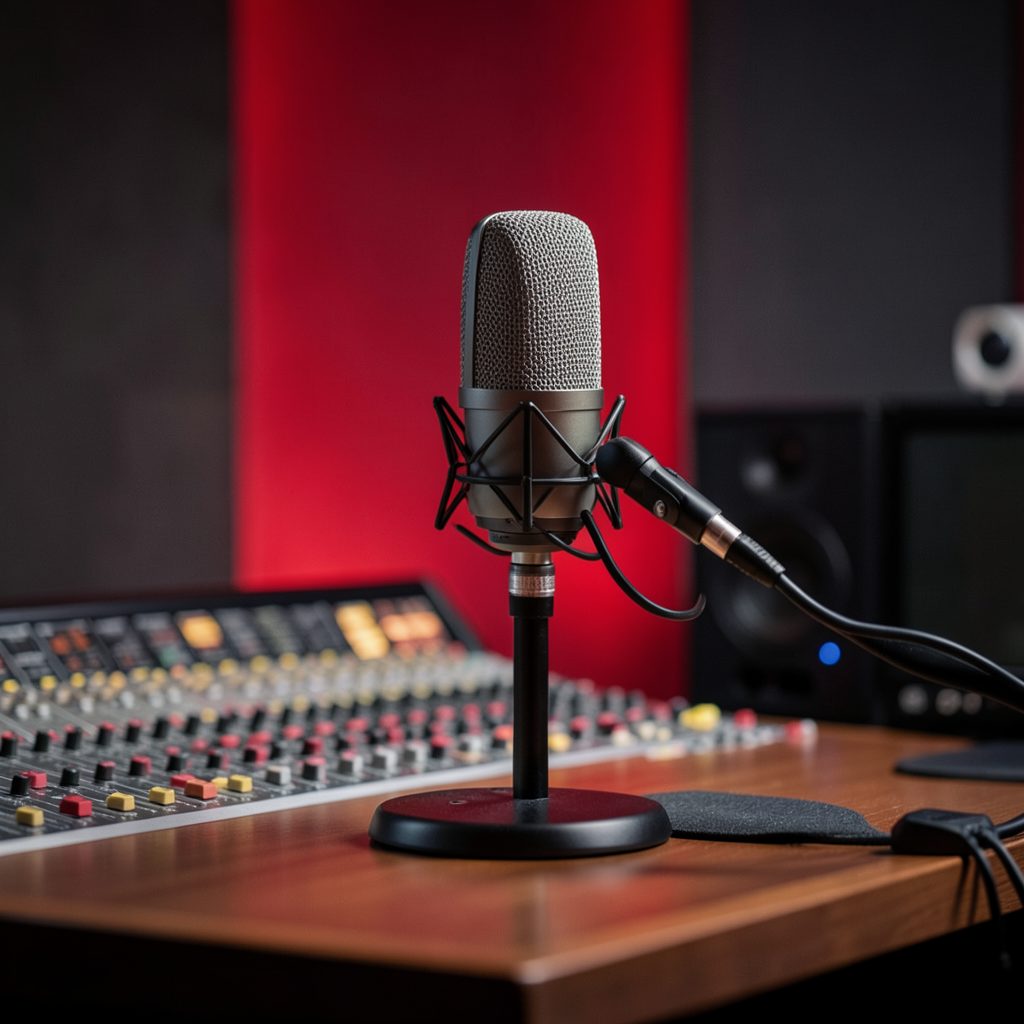
On Air & In Print
Andrea anchors the ITV lunchtime talk show Loose Women, which she joined in 2007, following 11 years as a core presenter on ITV's breakfast programme GMTV, a role she left on New Year's Eve 2008.
Alongside broadcasting, she has written for Red, Best, Scottish Woman and numerous weekly women's titles since starting as a freelance travel writer in 1993.
See Press & MediaReach & Recognition
A snapshot of the audience and impact behind Andrea's television, publishing and brand work.
This Girl Is On Fire
Andrea is CEO and Co-founder of the female empowerment platform This Girl Is On Fire, built around a mission to help women live, learn and thrive in a life they love.
Explore the PlatformScreen & Studio
Promotional and broadcast work created for television and corporate partners, including Barclaycard, Vistaprint and Wii Fit U.
Explore the Site
Find out more about Andrea's career, writing, media coverage and audience reach.
Get In Touch
For media, corporate or general enquiries, use the form below or reach out directly.
Contact details published on this site have appeared as +44 (0)20 7371 5444 / angharad.marsh@officialandreamclean.com and, on an earlier page, 020 7482 3282 / admin@officialandreamclean.com — please treat both as points of contact.